As I’ve shown previously[LINK], variations in temperature effectively boost the emissions of LW thermal radiation from the surface, leading to a reduction in the average global temperature[LINK]. Here, I will examine how changes to the outgoing longwave radiation flux relate to changes at the surface and in longwave radiation transmission.
There are two distinct ways that we could analyze such changes:
- Changes to global averages ― This involves looking at changes to the global average values that were used in the baseline global temperature formula.
- Global averages of changes ― This involves looking at changes as they occur in particular places and then averaging those changes globally.
The two approaches offer different ways of viewing changes that are both valid, yet decompose the picture differently. I’ll derive results for both approaches.
Changes to global averages
It was previously established that the average flux of outgoing longwave radiation,  , may be written as:
(1) 
Suppose each of these quantities is changed by some small amount, so that  ;
;  ;
;  ;
;  ; and
; and  . We can identify the relationships between these changes by substituting these expressions into the overall expression for
  , expanding and dropping any terms that are higher than first order in small quantities, and then subtracting off the expression for
  . This procedure yields:
(2) 
Or, making use of the equation for and giving symbols to the normalized individual terms:
(3) 
(4) 
(5) 
(6) 
(7) 
Global averages of changes
The Stefan-Boltzmann law tells us that the surface temperature,  , and the radiative flux of surface LW thermal radiation emissions,
  , are related by:
(8) 
where  is the Stefan-Boltzmann constant and
  is the emissivity.
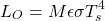
Since we are interested in the outgoing longwave radiation flux, , I will replace by  where
where  is the longwave transmission reduction factor associated with the non-transparency of the atmosphere in the longwave portion of the electromagnetic spectrum:
(9) 
Suppose each of these quantities is changed by some small amount, so that  ;
;  ;
;  ; and
; and  . We can identify the relationships between these changes by substituting these expressions into the overall expression for , expanding and dropping any terms that are higher than first order in small quantities, and then subtracting off the expression for
  . We then simplify the result by making use of the formula for . This procedure yields:
(10) 
Taking the average of both sides of this equation yields:
(11) 
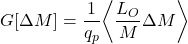
I’ll use the notation  to represent the energy balance change term for
  . In this,
  is a normalization factor:
(12) 
This normalization with respect to will lead to  being in units of temperature change.
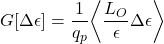
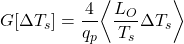
Thus:
(13) 
where
(14) 
(15) 
(16) 
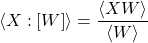
Define  to be the average of
  weighted by
  as defined by:
(17) 
Using this, the first two energy balance change terms can be rewritten as:
(18) 
(19) 
For the third change term, let’s divide the temperature change into the average temperature change, and variations around that average. This can be done by defining the temperature variation change anomaly,  , as follows:
(20) 
Using this definition to eliminate  in the equation for
  yields:
(21) 
(22) 
where
(23) 
(24) 
To support ease in talking about it, I will define the incremental temperature variation temperature shift, denoted  or
or  , to be the negation of
  . Consequently,
(25) 
(26) 
The sign of has been defined so that a positive value of corresponds to an increase in the average surface temperature when the system is in equilibrium. Changes in the global (and temporal) temperature distribution that make temperatures more uniform will shift the average surface temperature upward, while changes that make the temperature non-uniformity larger will shift the average surface temperature lower.
Putting all this together, we can now write the equation for the average change in outgoing longwave radiation as:
(27) 
This equation is the main result of our work here. It shows that any change in the outgoing longwave radiation flux can be decomposed into four terms, where those terms reflect:
- Change in the average surface temperature,

- Change in the atmospheric longwave transmission efficiency factor,

- Change in emissivity,

- Non-uniformity in temperature changes,
This equation for  is rigorously correct for (sufficiently small changes) and depends on nothing but the Stefan-Boltzmann law. Applications of this result will be valid as long as changes are small enough that it suffices to consider first terms only, with the effects of higher order terms being negligible.