Note: This page is highly mathematical.
Longwave (LW) thermal radiation emissions from a planet’s surface play an important role in planetary heat flows and the global energy balance. The overall energy balance operates at the level of global totals or, equivalently, global-average values.
With that in mind, let us obtain useful formulas for the average of the radiative flux of both surface longwave radiation emissions ( ) and outgoing longwave radiation emissions (
 ).
).
Average Surface Longwave Radiation Emissions (SLR)
The Stefan-Boltzmann (SB) law tells us that the surface temperature,  , and the radiative flux of surface LW thermal radiation emissions,
  , are related by:
(1) 
where  is the Stefan-Boltzmann constant and
  is the emissivity, a value between 0 and 1, typically fairly close to 1, which depends the the characteristics of the material doing the emitting.
The surface temperature varies in time, and also depending on where one is on the planet. Emissivity varies also, mostly by location, but sometimes over time.
Climate data is usually averaged over some time window. For purposes of looking at the global energy balance, it is also useful to average over location, i.e, latitude and longitude.
I will denote the average of a quantity  over a time window as
  , and the average of over latitude and longitude as
  . (Formulas for calculating those averages are available here.) I will denote that result of averaging over both a time window and latitude and longitude as
  . You can calculate by averaging over time and longitude and latitude in either order, and you’ll end up with the same result. In other words, .
(2) 
If two quantities are equal, then the average values of those quantities will also be equal. So, we can average equation the SB equation to obtain:
(3) 
Because is a constant, it’s okay to bring it outside of the average. But because both and vary, they can’t be average separately.
I like to see how things look when expressed using the concept of a weighted average. I’ll use the notation  to denote the average of , weighted by
  . This is calculated as:
(4) 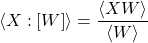
This allows  to be expressed as
  . Sometimes I find this helpful in thinking about what an expression means. But, your mileage may vary on this issue. The formulation with or without weighted averages is equally valid.
The consequence of this definition is that  still provides information about “typical” values of , but it treats values of as more important when is large and less important when is small.
Given that definition, we can rewrite the equation for  as:
as:
(5) 
where the global emissivity,  , or standardly-weighted average emissivity,
  , is defined as
(6) 
Because or is a weighted average of , it is constrained to be between between the minimum and maximum values of .
Alternatively, this could be expressed as:
(7) 
where  is defined as
(8) 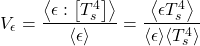
The factor may be thought of as the temperature-variation emissivity adjustment factor. If varies only within a small range, then will necessarily be close to 1.
It is convenient to be able to express the relationship between average surface emissions, , and average surface temperature,
  . We can do that by defining the quantity,
  :
:
(9) 
Then, the equation for becomes:
(10) 
What is interesting to notice about this is that, in expressing the relationship between emissions and temperature in terms of the average temperature, , it is as if we have had to replace the emissivity with the emissivity multiplied by . So, acts as a factor to effectively modify the emissivity. Does it increase or decrease the emissivity?
It can be proven mathematically (via an application of Holder’s inequality) that it is always true that:
(11) 
Thus, it’s clear that effectively increases emissivity. So, I’ll refer to as the temperature-variation emissivity boost factor.
Note that while the “adjustment factor” will never adjust the emissivity to be outside the range 0 to 1, the “boost factor” could potentially lead to an effective emissivity,  greater than 1.
What we have achieved here is a transformation of the Stefan-Boltzmann equation from an equation that applies at an individual location and time to a similar equation which applies to suitably averaged values, , , and . In the process, it has been necessary to introduce a new parameter,  , which effectively boosts the emissivity. This reflects the fact that a system in which the temperature varies from the average value emits more than a system with a uniform temperature. This is true whether those variations occur over time or between locations around the globe.
Average Outgoing Longwave Radiation Emissions (OLR)
The Greenhouse effect is defined quantitatively as:
(12) 
I can also be useful to work with the dimensionless normalized Greenhouse effect:
(13) 
The symbol  is used for this quantity in IPCC reports, but for simplicity, I typically use the symbol
  .
.
The quantity can be thought of either as the normalized Greenhouse effect or as the longwave effective absorptance (LEA) of the atmosphere. The standard definition of absorptance is the fraction of radiation power incident on an absorbing medium that is absorbed. In comparison, the LEA, , is the the fraction of longwave thermal radiation power emitted by the surface that, as viewed from space, is absorbed by the atmosphere without having been replaced by an equivalent amount of power from atmospheric longwave emissions. So, LEA is like absorptance, but it accounts for both absorption and emissions.
Note that  . For a planet with a longwave-transparent atmosphere (with nothing in it to absorb, emit, reflect, or scatter LW radiation) the value of would necessarily have 0.
Given the definition of , it follows that:
(14) 
(15) 
Taking the average of the latter equation:
(16) 
This can be written as:
(17) 
where the global normalized GHE or global LEA,  , the standard-weighted average ,
  , and emission-variability LEA adjustment factor,
  , are defined as:
(18) 
(19) 
Because  is a weighted average of , it constrained, to be between the minimum and maximum values of . If varies only within a small range, then will necessarily be close to 1.
Combining our equation for  with the prior equation for
  leads to:
(20) 
Conclusion
This analysis provides formulas for the global average radiative flux of longwave radiation thermal emissions from the surface, , and the global average radiative flux of longwave radiation thermal emissions outgoing from the top of the atmosphere, 
These are exact results, involving no approximations or assumptions.
The results rely only on the definitions of the terms involved. Beyond those definitions, the resulting formulas are the exact result of mathematical transformations and tautologies.
The well-established Stefan-Boltzmann law for thermal emissions is the only principle of physics that has been used. However, the SB law can be considered to be simply a definition of the emissivity, . So, in that sense, this analysis has been purely mathematical, with full mathematical rigor.