Note: This page is highly mathematical.
Let’s look at the equation which governs the propagation of thermal radiation through a partially-transparent medium without significant scattering.
This topic is also addressed in Chapter 8 of Petty, Grant (2006). A First Course in Radiation Physics (2nd ed.). Madison, WI: Sundog Publishing.
Propagation of radiation intensity along direction of travel
Let  be the intensity1More technically, this quantity is called spectral radiance. (W sr-1 m-2 Hz-1) of thermal radiation at frequency
  propagating through the medium. It is assumed that the intensity entering the medium is uniform over a plane where the radiation enters the medium. Then, the rate of change in the intensity relative to the distance traveled,
  , is given by the Schwartzchild equation for radiative transfer:
(1) 
Here,  is the numerical density of absorbing/emitting molecules (molecules/m3),
  is the absorption cross section of each molecule (m2),
  is the temperature of the medium (Kelvin), and
  is the Planck spectrum that would be emitted by a radiating black-body.
The first term reflects absorption, while the second term reflects spontaneous thermal emissions within the medium. It has been assumed that molecular collisions are sufficiently frequent that local thermal equilibrium holds, which results in the rate of stimulated emissions being negligible. (This is the case in Earth’s troposphere.)
The solution to the Schwartzchild equation can be expressed as:
(2) 
where
(3) 
(4) 
(5) ![\begin{equation*} A_{\nu,\Omega}(s^\prime, s) = 1 - \exp\left[ -\tau_{\nu,\Omega}(s^{\prime}, s) \right] \end{equation*}](https://test1.climatepuzzles.org/wp-content/ql-cache/quicklatex.com-1a29cb75cf79e2740e07b31967a79f12_l3.png "Rendered by QuickLaTeX.com")
(6) ![\begin{equation*} W_{\nu,\Omega}(s^\prime, s) = n(s^\prime) \,\sigma_\nu(s^\prime) \, \left[ 1 - A_{\nu,\Omega}(s^\prime, s) \right] \end{equation*}](https://test1.climatepuzzles.org/wp-content/ql-cache/quicklatex.com-8d0ea0cdb8d5102b46c6e5ca05184d21_l3.png "Rendered by QuickLaTeX.com")
The newly introduced quantities are:
 — The net amount by which the incident intensity is reduced after propagating for a distance , i.e., the amount that is absorbed without this loss being compensated for by a comparable amount of emissions from within the medium.
 — The optical thickness associated with propagation from
  to .
to .-
 — The absorptance (fraction absorbed) associated with propagation from to .
  — The intensity emissions weighting function, i.e., a weight factor for black-body emissions at different points along the propagation path.
Interpreting the initial result
A weighted average
It may be further verified that:
(7) 
This allows us to write:
(8) 
(9) 
where the weighted average  is defined as
(10) ![\begin{equation*} \exw{f_0,\;f(s)}{W_s}_s = L_{\nu,\Omega}(0)\; \left[1 - \int_0^s W_s(s^\prime, s) \,\dd s^\prime \right] + \int_0^s f(s) \,W_s(s^\prime, s) \,\dd s^\prime \end{equation*}](https://test1.climatepuzzles.org/wp-content/ql-cache/quicklatex.com-aba5ab880e61b12fc77d91364384e22e_l3.png "Rendered by QuickLaTeX.com")
This allows us to interpret  as being a weighted average of thermal emissions entering the medium and emitted inside it, with
 ![[1-A_{\nu,\Omega}(0,s)]](https://test1.climatepuzzles.org/wp-content/ql-cache/quicklatex.com-2a78a9a70ada41cfdb6cb3da5bc661cb_l3.png "Rendered by QuickLaTeX.com") and
and  specifying the weighting to be used in computing the average.
Note that, as one might expect from a weighted average:
(11) 
Effect of uniform temperature
Suppose that we assume the incident thermal radiation at frequency has equal intensity in all directions, so that it is equivalent to the thermal radiation from a black-body at temperature,  :
:
(12) 
Then, if the temperature of the medium uniformly equals , then  becomes uniformly
  , and we find:
(13) 
In the absence of temperature changes within the medium, the exiting intensity will be the same as what entered. For the net spectral radiance exiting the medium to be less than what entered, the overall weighted mean temperature must be lower than the brightness temperature of the entering radiation.
Effect of increasing concentration
What is the effect of increasing the concentration of the absorbing and emitting molecules? This would be expressed as a proportionate increase in the number density, , at all locations within the medium, and a corresponding increase in absorptance. Examining the formula for the weight, , it is apparent that, in response to an increase in concentration:
- the entering radiation will be deemphasized;
- emissions earlier along the propagation path will be deemphasized;
- emissions further along the propagation path will become more heavily weighted.
Propagation of radiation flux
The spectral radiance involves radiation traveling in many different directions. The directions of travel may be specified using spherical coordinates,  , where
  is the zenith angle and
  is the azimuthal angle.
Let  be the flux2Technically, this is the spectral flux density Even more rigorously, the amount entering is called the spectral irradiance, while the amount leaving is called the spectral radiosity—or the spectral exitance, if it all the radiation is associated with thermal emissions. Since I’m looking a propagation, the radiation is leaving one section of medium and entering the next. So, I’m using the more generic term, spectral flux density, and simplifying this to simply “flux” to be less formal. of thermal radiation (W m-2 Hz-1) at frequency passing through a plane a distance
  from the plane where the radiation entered the medium. The flux is related to the intensity by an integration over all directions within a hemisphere, i.e., all directions with at least some component of travel in the same direction. In particular:
(14) 
The factor  is needed to translate flux in the direction of travel to flux relative to the plane where the flux density is being measured. The factor
  is required to reflect integration over the hemisphere.
The black-body spectral radiance, , is the same in all directions. This makes it simple to calculate the analogously-defined hemispheric black-body flux,  :
:
(15) 
Let us assume that the intensity entering the medium,  , is also uniform in all directions. This leads to:
(16) 
Now, let’s work on transforming our solution for intensity into a solution for flux. Recognizing that  , integrals with respect to
  become integrals with respect to
  . Integrating both sides of the equation with respect to is simple, since we assume all quantities to be independent of . Finally, we integrate both sides of the equation for with respect to
  . This procedure yields:
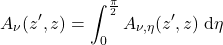
(17) 
where
(18) 
(19) 
(20) ![\begin{equation*} A_{\nu,\eta}(z^\prime, z) = 2\,\sin\eta \,\cos\eta\;\exp\left[ -\frac{\tau_{\nu}(z^{\prime}, z)}{\cos\eta} \right] \end{equation*}](https://test1.climatepuzzles.org/wp-content/ql-cache/quicklatex.com-f9ac5204532394e8e44f9a0e52139274_l3.png "Rendered by QuickLaTeX.com")
(21) 
(22) ![\begin{equation*} W_{\nu}(z^\prime, z) = n(z^\prime) \,\sigma_\nu(z^\prime) \, \left[1 - \int_0^\frac{\pi}{2} \int_{z^{\prime}}^z \frac{A_{\nu,\eta}(z^{\prime\prime}, z)}{\cos\eta}\;\dd z^{\prime\prime}\;\dd\eta \right] \end{equation*}](https://test1.climatepuzzles.org/wp-content/ql-cache/quicklatex.com-aafc39cdf1fa413e7f1b5be8e036edd7_l3.png "Rendered by QuickLaTeX.com")
We could also write:
(23) 
(24) 
The key quantities here (for a particular frequency ) may be identified as:
 — The net amount by which the incident flux is reduced at a plane a distance beyond the initial plane, i.e., the amount that is absorbed without this loss being compensated for by a comparable amount of emissions from within the medium. When considering the propagation of thermal radiation flux upward from Earth’s surface to TOA, is the Greenhouse effect at frequency .
 — The absorption coefficient at location .
 — The optical thickness associated with propagation from
  to for radiation propagating in a direction normal to the plane in which flux is measured.
 — The absorptance (fraction absorbed) associated with propagation of flux from to .
 — The flux emissions weighting function, i.e., a weight factor for black-body emissions at planes.
We can interpret the flux exiting the medium,  , as being the average of thermal emissions entering the medium and emitted inside it:
(25) 
Spectral integration
Let  be the flux integrated over all frequencies:
(26) 
(27) 
(28) 
At entry to the medium, the overall brightness temperature  is defined so that
(29) 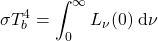
where  is the Stefan-Boltzmann constant. So:
Application to Atmosphere
Downwelling radiation
The emissivity weighting function is different for propagation in the upwelling and downwelling directions. There is essentially no downwelling thermal radiation at the top of the atmosphere. So, at the surface, the downwelling thermal radiation flux is given by:
(30) 
where  is the emissions weighting function for downwelling radiation.
Upwelling radiation
Upwelling thermal radiation is given by:
(31) 
where  is the emissions weighting function for upwelling radiation.
The Greenhouse effect,  , is given by:
(32) 
where the emissions weighting function for upwelling radiation is evaluated at the top of the atmosphere.
Normalized Greenhouse effect
Let us define the normalized Greenhouse effect,  , as:
, as:
(33) 
Spectral normalized Greenhouse effect
Let us define the spectral normalized Greenhouse effect,  , for frequency as:
(34) 
(35) 
(36) 
Then
(37) 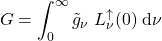
This may be used to compute the normalized Greenhouse effect as:
(38) 
In other words, is the average of  over frequency as weighted by the flux emmited by the surface,
  .
.
Addressing simplifications
This analysis relied on assumptions that are only valid in the troposphere. However, it is possible to generalize this sort of analysis to address propagation throughout the atmosphere.