Note: This post is highly mathematical.
On other pages, I have derived rigorous formulas for a planet’s thermal radiation emissions to space and incoming and stored thermal energy. These analyses are expressed in terms of global average quantities or equivalently in terms of total energy summed over the globe over some period of time. Familiarity with those pages is likely be needed in order to fully understand the analysis presented here.
Table of Contents
Preliminaries
Conservation of Energy
One of the most fundamental laws of physics is the Law of Conservation of Energy. One consequence of this law, is that there is a simple relationship between the rate of energy coming into the “climate zone” of a planet,  , the rate of energy leaving the planet,
  , and the rate at which energy accumulates within that planetary climate zone,
  :
:
(1) 
This equation states that any energy that enters the system must either leave the system or be retained inside the system. Since energy is neither created nor destroyed, this equation must hold at all times.
Expanding the Terms of the Energy Conservation Equation
The term for the rate of energy entering the system is given more explicitly by:
(2) 
where  is the incident solar irradiance at the top of the atmosphere (TOA);
  is the albedo, defined as the fraction of solar irradiance reflected back to space; and
  is the sum of all other heating sources entering the system. Mainstream science indicates that the term is negligibly small for Earth; but the term is included in this analysis so that our result will be rigorously correct without any approximations.
The term for the rate of energy leaving the system is labeled , for outgoing longwave radiation. This is because the only way that any significant amount of energy can escape a planet into space is in the form of electromagnetic radiation. In practice, this happens in the form of longwave thermal radiation emitted by matter.
The only other way energy could escape the system would be if there was a net heat flow towards the core of the planet. However, in general, geothermal heat flows in the opposite direction, out of the interior of the planet, not into it. This leaves thermal radiation emissions to space as the only mechanism for cooling the system as a whole.
The power of outgoing longwave radiation may be expressed as:
(3) 
(4) 
In this equation,  is the mean global surface temperature;
  is the Stefan-Boltzmann constant;
  is the global mean emissivity of the surface (weighted by
  so that warmer areas weigh more heavily in the average);
  is a factor larger than 1 which I call the temperature-variation emissions boost factor (TVEB); and
  is the normalized Greenhouse effect, a dimensionless quantity less than 1.
The temperature-variation emissions boost factor (TVEB) is explicitly given by:
(5) 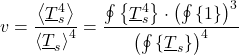
where  denotes the average of the quantity
  over the surface of the globe and over some period of time; and
  denotes the sum (or integration) of the quantity over the surface of the globe and over some period of time. These quantities are simply related, insofar as
  where the constant
  is simply the surface area of the planet times the duration of the time period over which quantities (typically energies) are being summed.
The factor TVEB, or , emerges during the averaging or summing process, because an object whose temperature varies emits more thermal radiation than an object with the same average surface temperature but with a uniform temperature. In the case of the Moon, the TVEB factor contributes to the Moon being around 90℃ colder than the Earth, on average, despite the Moon absorbing more sunlight per unit area than the Earth does. (The effect of this TVEB factor on Earth is much smaller, since Earth experiences much small temperature variations.)
The normalized Greenhouse effect, , is explicitly given by:
(6) 
where  is the power of surface-emitted longwave radiation. The quantity, , indicates what fraction of thermal radiation power emitted by the surface is not reflected in the power of thermal radiation that escapes to space.
Note that if the atmosphere of a planet was transparent to thermal radiation emitted by the surface, this would inherently mean that the power of thermal radiation reaching space, would have to be identical to the power of thermal radiation leaving the surface, , so that  . In other words, a non-zero Greenhouse effect is possible only because of the presence of materials in the atmosphere which absorb or scatter thermal radiation emitted by the surface.
For purposes of this formula, the quantity can simply be treated as a measurable quantity which plays an essential role in the formula we are deriving. We also know that it has a non-zero value only due the presence of materials that absorb or scatter thermal radiation. Although more can be said about this factor, knowing that much is sufficient for purposes of this analysis.
Expanded Conservation of Energy Equation
Now we can bring the various terms together into an expanded version of the energy conservation equation:
(7) 
We can rearrange the above equation to solve for the surface-emitted longwave radiation:
(8) 
Temperature
Non-Equilibrium Temperature Formula
Going one step further, we can solve for the mean global surface temperature (MGST), :
(9) ![\begin{equation*} \tsurfg = \left[ \frac{ \left(1-\albedog\right)\,\xglob\isi \,+\, \xglob{S_x} - \xglob{Q_s}}{ \left(1 - \ngheg \right) \, \xglob\emis \, \tveb \, \sigma } \right]^\frac{1}{4} \end{equation*}](https://test1.climatepuzzles.org/wp-content/ql-cache/quicklatex.com-f7a968de1d66e8eedd7fa81491d0b71f_l3.png "Rendered by QuickLaTeX.com")
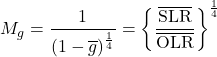
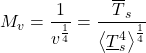
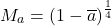
This can be broken into distinct factors as follows:
(10) 
where
(11) 
(12) 
(13) 
(14) 
(15) ![\begin{equation*} M_x = \left[ 1 + \frac{\xglob{S_x}}{M_\albedo^4 \, \xglob\isi} \right]^\frac{1}{4} \end{equation*}](https://test1.climatepuzzles.org/wp-content/ql-cache/quicklatex.com-333f23ab56d01af72441acb15a0442c5_l3.png "Rendered by QuickLaTeX.com")
(16) ![\begin{equation*} T_\mathrm{sub} = \left[ \frac{\xglob\isi}{\sigma} \right]^\frac{1}{4} \end{equation*}](https://test1.climatepuzzles.org/wp-content/ql-cache/quicklatex.com-262260020001376db5a6a472bbd4c72c_l3.png "Rendered by QuickLaTeX.com")
(17) ![\begin{equation*} T_\mathrm{subn} = \left[ T_\mathrm{sub}^4 \,-\, \frac{\xglob{Q_s}}{ M_x^4\,M_\albedo^4\,\sigma } \right]^\frac{1}{4} \end{equation*}](https://test1.climatepuzzles.org/wp-content/ql-cache/quicklatex.com-be357020b93032b256d35526b653acc7_l3.png "Rendered by QuickLaTeX.com")
The factors  ,
,  ,
,  ,
,  , and
, and  indicate the multiplicative effect on temperature of, respectively, the Greenhouse effect, surface temperature variations, surface emissivity, albedo, and non-solar heating.
The temperatures  and
and  represent, respectively, the equilibrium and non-equilibrium temperatures of a solar-heated-only uniform-temperature blackbody version of the planet.
Expressing the conservation of energy equation in terms of the surface brightness temperature leads to the equation:
Equilibrium Temperature Formula
When a planet is in thermal equilibrium, the energy storage term, is zero. I will denote the temperature when the planet is in equilibrium by MGST or
or  . Setting to zero in the above expression for mean global surface temperature, we find:
(18) 
At any given point in time, it will not necessarily be the case that equals . However, it will inevitably be the case that, as changes, will “chase” it, i.e., will shift towards the current value of .
This is clear because when the temperature is lower than the equilibrium temperature ( ), this corresponds to a situation in which the stored internal energy of the climate system is increasing (
 ), as occurs when temperature rises. Similarly, when the temperature is higher than the equilibrium temperature (
 ), this corresponds to a situation in which the stored internal energy of the climate system is decreasing (
 ), as occurs when temperature is falling.
Thus, although MGST might not be the current temperature of a planet, it represents the temperature that the planetary surface is heading towards.
Discussion
Status of these Formulas
The above formulas for mean global temperature are direct consequences of fundamental principles of physics:
- The non-equilibrium result is simply a transformed version of an equation for conservation of energy.
- All mathematical transformations were exact, involving no approximations.
- The only assumption made about the planet is that materials on the planetary surface have a defined temperature (at any given position on their surface and at any given moment).1Technically, the condition is that the surfaces of materials are in Local Thermal Equilibrium. This does not preclude temperature changing fairly rapidly in time, or varying over relatively short distances. Under natural conditions at the Earth’s surface, this condition is known to be reliably satisfied. This condition being satisfied means that it is valid to use the Sefan-Boltzmann law (with emissivity included to account for real materials) to specify the power of thermal radiation emitted by surfaces. This law, and the law of conservation of energy, are the only principles of physics required in order to derive these results.
Thus, the formulas for equilibrium and non-equilibrium mean global surface temperature are scientifically rigorously and mathematically exact.
What affects Mean Surface Temperature
The derived formula indicates that the following quantities directly affect the equilibrium Mean Global Surface Temperature (MGST):
- Incoming solar irradiance,
- Greenhouse effect (i.e., reduction of thermal radiation emissions to space in comparison to thermal radiation emissions from the surface),
- Albedo,
- Emissivity,

- Temperature variations,
- Non-solar heating,
These items are listed in approximate order of decreasing importance with respect to Earth’s baseline temperature, as indicated by the magnitude of  , where
  is the temperature multiplication factor associated with each quantity. Mainstream science estimates the effects of non-solar heating on Earth as being far smaller than the effects of the first 5 factors.
These are the ONLY factors that directly effect the equilibrium temperature.
This result does not preclude other factors affecting planetary temperature indirectly. However, any phenomenon that affects planetary temperature does so by affecting one of the six quantities listed above. For example:
- cloud coverage affects both albedo (reflection of shortwave radiation) and the Greenhouse effect (net absorption of longwave radiation);
- the extent of ice and snow coverage in high latitudes affects albedo;
- when deciduous forests drop their leaves in the fall, this produces a small change in emissivity which is measurable by satellites;
- the magnitude of the Greenhouse effect is affected by the concentrations of Greenhouse gasses (including that of water vapor), cloud coverage, and the atmospheric temperature profile (i.e., the lapse rate);
- ocean currents affect the distribution of temperatures on the Earth’s surface, affecting temperature variations, and also affecting humidity levels (and possibly local lapse rates), and hence the Greenhouse effect.
Consequently, each of these phenomena (as well as others) can potentially affect the mean global surface temperature.
Related Topics
Other Reference Temperatures
The temperature formulas above are expressed in terms of and , the equilibrium and non-equilibrium solar-heating-only uniform-temperature blackbody temperatures. In some cases, it may be useful to consider other reference temperatures. For example, we can define:
(19) 
(20) 
(21) 
(22) 
These temperatures are:
 — The equilibrium temperature of a solar-heating-only reflective uniform-temperature planet which radiates as a blackbody.
 — The equilibrium temperature of a solar-heating-only reflective uniform-temperature planet which radiates as a grey body (i.e., emissivity less than 1).
 — The equilibrium temperature of a solar-heating-only reflective variable-temperature planet which radiates as a blackbody.
 — The equilibrium temperature of a solar-heating-only reflective variable-temperature planet which radiates as a grey body (i.e., emissivity less than 1).
Relating TOA Energy Imbalance to these Quantities
One of the quantities that satellites orbiting Earth measure is the TOA energy imbalance,  . This is equal to the net absorbed solar irradiance minus the outgoing longwave radiation:
(23) 
If we go back to the original energy conservation equation, and expand only the term for , and combine it with this equation for , we find:
(24) 
Thus, we see that the TOA energy imbalance sets a lower bound on how much energy is being added to the store of internal energy in the climate system, i.e., how much warming is happening.
If a significant non-solar heating term, , was present, this would indicate that even more thermal energy is being retained, leading to more heating of matter in the climate system. Postulating a heating source that is not accounted for would not explain the observed TOA energy imbalance; it would add to it, creating a larger actual energy imbalance and imply more heating than would be expected from the TOA energy imbalance alone.
If both the TOA imbalance and the energy storage rate are known, this allows one to calculate the size of the additional heating term :
(25) 
When applying this equation to estimate , if there is uncertainty in the values of and , this translates into uncertainty in the value of .
Temperature “Discrepancy” due to the Greenhouse Effect
In the case of Earth, it is often said that the Greenhouse effect resolves a “33℃ discrepancy” in Earth’s temperature.
Talk of a 33℃ discrepancy arises from the observation that  33℃. (If we were to consider only the GHE as it is now defined technically, we would look at
  35℃. So, the warming that the GHE accounts for on Earth is actually 35℃, though few people talk about the issue in those terms.)
Other heating mechanisms are sometimes proposed as a hypothetical alternative to the Greenhouse effect. However, such alternative heating mechanisms would not and could not address the issue. Such mechanisms would alter the term . However, the “33℃ discrepancy” specifically relates to the the measured value of the factor being about 1.14 rather than 1.
Changing the value of the term would would alter the planetary temperature. But, it would in no way address the empirical fact that the term is not 1. The “33℃” specifically relates to the measured value of the GHE factor (plus, implicitly, the factor). That observation cannot be altered by postulating a different value for the non-solar heating factor . A 35℃ “discrepancy” will always exist in the energy conservation equation when the GHE is omitted from calculations, regardless of the presence or absence of any non-solar heat sources.
Working with Surface Brightness Temperature
When working with some datasets, it may be convenient to work with the surface “brightness temperature” rather than the actual surface temperature. The local surface brightness temperature  is given by:
(26) 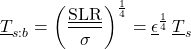
The surface brightness temperature can be determined by knowing the surface longwave emissions,  , even if the emissivity of the surface is unknown.
The global value is related to the local surface brightness temperature by the equation:
(27) 
where
(28) 
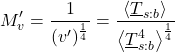
The conservation of energy equation can be expressed in terms of surface brightness temperature as follows:
(29) 
where
(30) 
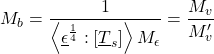
The global mean surface temperature, is related to the global mean surface brightness temperature by:
(31) 
where the surface brightness temperature multiplier,  , is defined by:
(32) 
These equations are sufficient to allow one to analyze planetary temperature in terms of surface brightness temperature, , and then subsequently relate this to the actual surface temperature, , once information on emissivty,  , becomes available.